
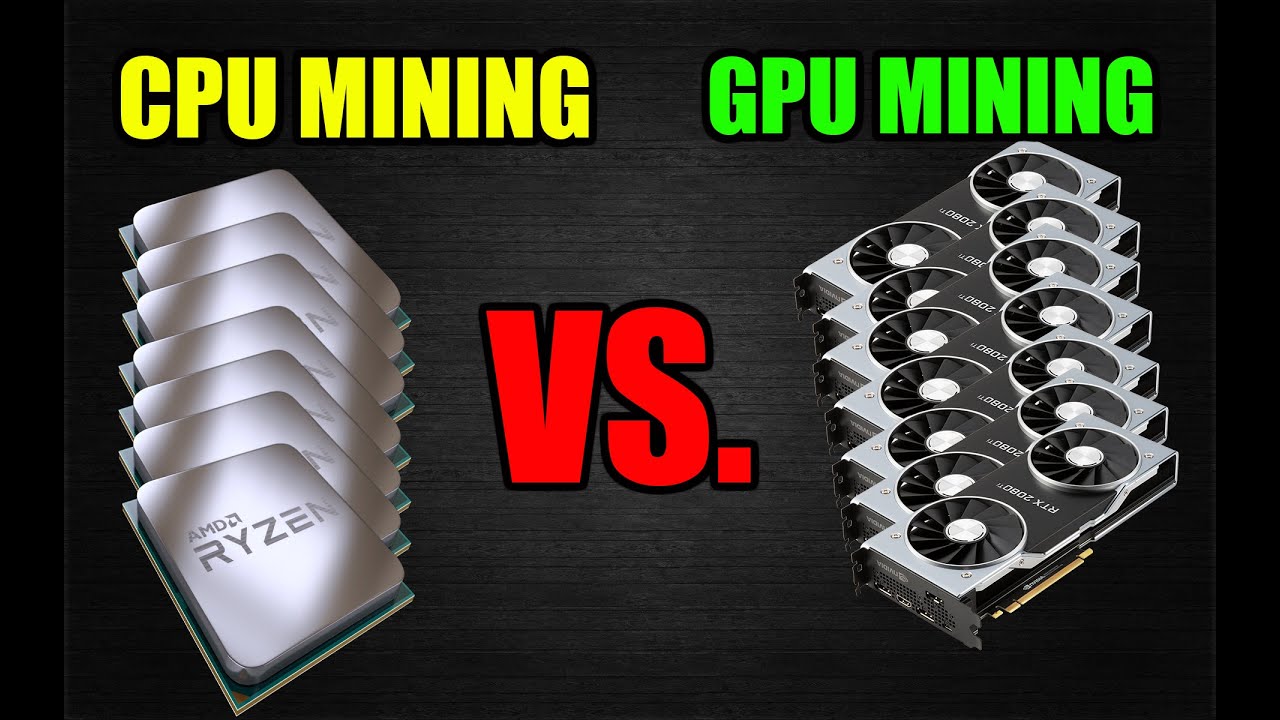
GPU vs CPU Mining
When choosing mining hardware, one of the most important decisions is selecting between GPU mining and CPU mining. Both have their strengths and weaknesses, which should be carefully considered depending on the cryptocurrency being mined.
CPU Mining
How It Works: CPUs are capable of handling general computational tasks, but they are not particularly efficient for mining cryptocurrencies. Early in the history of Bitcoin and other coins, miners used CPUs because they were the only option available. Today, CPU mining is more limited, primarily used for less complex coins or coins that use algorithms that favor CPUs.
Performance:Compared to GPUs, CPUs are significantly slower at solving cryptographic puzzles. The computational power of a CPU is limited, and they do not have the parallel processing capabilities of GPUs. Consequently, CPU mining is often unprofitable for mainstream coins like Bitcoin or Ethereum due to the high mining difficulty.
Use Cases:CPU mining is still useful for cryptocurrencies like Monero (XMR), which use the RandomX algorithm, designed to be ASIC-resistant and optimized for CPU mining. However, the profitability of CPU mining is heavily dependent on the coin’s mining algorithm and network difficulty.
GPU Mining
How It Works:GPUs were originally designed for rendering graphics in video games. However, their ability to handle many tasks at once (parallel processing) makes them perfect for mining. In the mining world, GPUs are often used in "mining rigs" that can contain several graphics cards working together to solve cryptographic problems.
Performance: GPUs far outperform CPUs in terms of mining speed. They are particularly well-suited for mining algorithms that require large-scale parallel computations, such as Ethash (used in Ethereum) or Kawpow (used in Ravencoin). GPUs have significantly higher hash rates than CPUs, making them much more effective and profitable for most modern cryptocurrencies.
Use Cases:GPU mining is still one of the most popular methods for mining various altcoins, especially those that require memory-intensive hashing algorithms, such as Ethereum, Ravencoin, and others. While Ethereum has transitioned to proof-of-stake (PoS), many coins continue to use proof-of-work (PoW), and GPUs remain a popular choice for miners.
Comparison
Performance and Efficiency:GPUs provide significantly higher hash rates compared to CPUs. While a CPU might produce a hash rate of 10 to 100 hashes per second, GPUs can achieve rates of several thousand to millions of hashes per second.
Power Consumption:GPUs consume more power than CPUs, but their higher hash rates mean that they are more efficient overall. In the case of CPU mining, the amount of energy required per hash is generally much higher, making CPU mining less energy-efficient compared to GPU mining.
Profitability:Due to their higher performance and efficiency, GPUs are far more profitable than CPUs for mining most major cryptocurrencies. CPU mining is often no longer viable for large-scale operations, especially for well-established coins like Bitcoin or Ethereum.